
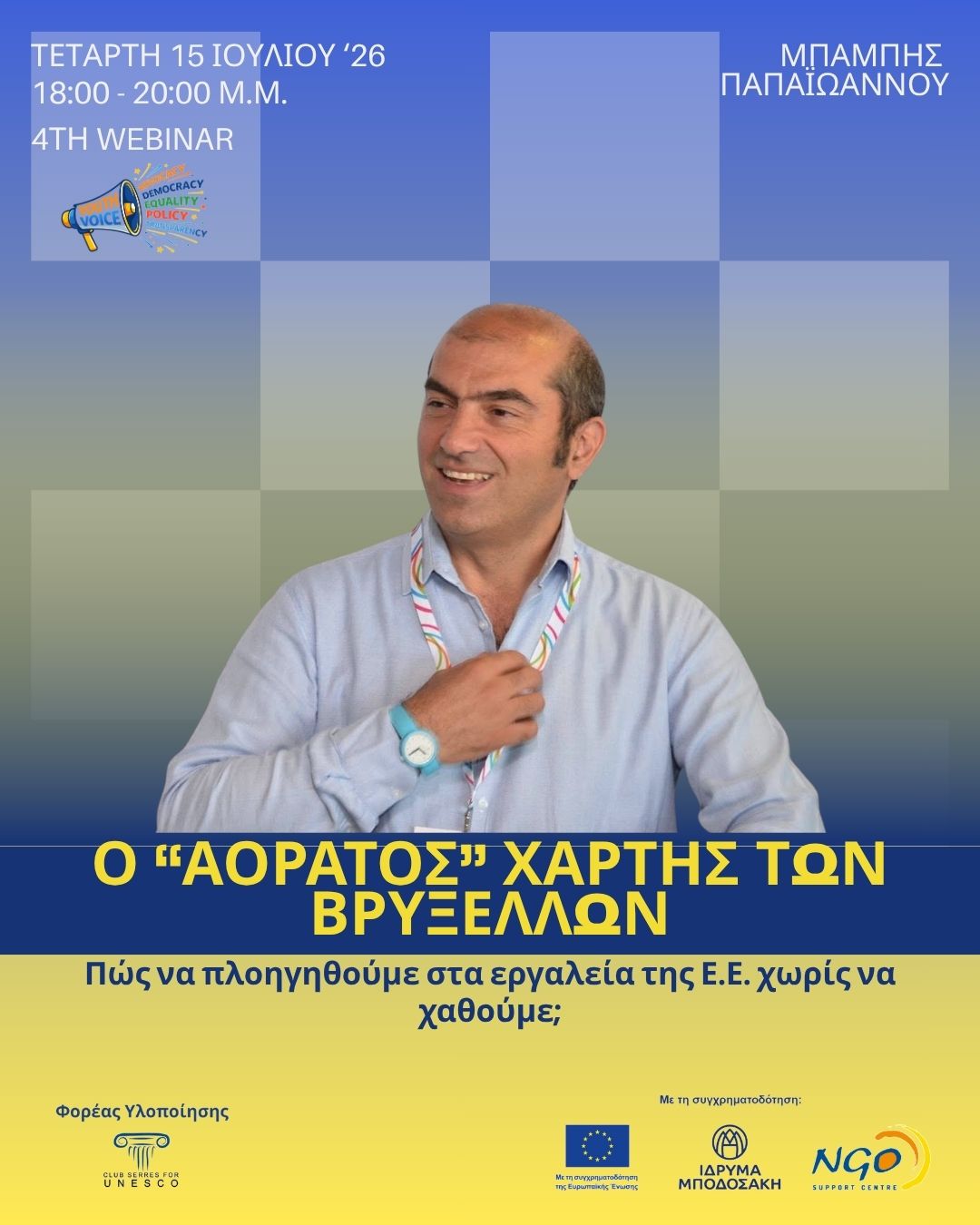
4o Webinar, Ο “αόρατος” χάρτης των Βρυξελλών
Webinar from 15 th of July 2026, hosted by Babis Papaioannou – Ο ‘αόρατος’ χάρτης των
Βρυξελλών, trans. to The Invisible Map of Brussels
Wednesday’s webinar was the last webinar of 4 webinars on the Youth Voice campaign series, as part of the European Union (EU) initiative in Greece and was hosted by the wonderful Babis Papaioannou. Previous webinars included various interesting themes such as Democracy, Human Rights and Inclusivity within Community. In The Invisible Map of Brussels, two different topics were discussed in detail by Papaioannou; the messages that we are getting from Brussels and how we use that to support our youth campaigns and projects and what are the EU’s new goals, needs, and expectations in the coming year of 2028.
Initially, Papaioannou engaged us with the question of “What does the EU mean to you?”,comparing our answers with the two most common answers from 13–16-year-olds of today. First, the Euro. Connecting us and the EU through money and the economy. Papaioannou explained it as a phenomenon initiated by mass social media consumption and different family experiences. Secondly, the ease of transportation. Unifying youth with other nations without being stopped by airport security and being questioned for hours upon hours, or any form of Visa problems. So, now it comes to mind the following question. Where EU money goes and how do we get our proposals to be approved and achieve its aims, as set out by the rules of the European Committee, to help our youth and make significant change in society?
This was summarised into 5 key steps:
1. Identify a significant problem within our local area and how we can solve it. Then, we
research how other organisations have tackled a similar problem to ours.
2. Find specialists outside of the local area that can help us understand how to apply and
solve our problem via social media or through other EU university initiatives.
3. Aims and objectives of our proposal need to be as close as possible to reality; this can be
checked through European Youth Portal, where announcements on youth issues can be found
to see if our proposal can be made a reality.
4. Think about how our proposal is going to be applied. National advisers are there to commit
to the job of maturing these proposals into practice as the EU will ask for obligations to be
filled for the next 5 years with frequent check-ins.
5. Final product must be what we set out in our proposal which was approved by the EU,
never anything less. If something changes, it must immediately be mentioned to the relevant
authorities.
However, the biggest setback to all of this is the lack of a centralised, national youth committee to be able to support with the formation of youth programmes in terms of providing advocacy for all youth in Greece. Another setback that Papaioannou reminded us of, was ourselves, we need to have the self-assurance that the proposal will be approved and all its goals will be achieved to fundamentally support our youth in their futures. Papaioannou linked this to the goals that the EU currently plans to embrace and support our youth. Two
main strategies were mentioned:
1. Intergenerational Fairness Strategies –old and new generational issues to create
collaboration between the generations to support decisions on our youth.
2. Preparedness Strategy – Over time, it is inevitable that there will be risks such as through
the internet, climate change and technology. For example, how would the youth survive for
72 hours without internet, when we are all heavily reliant on it. The aim is to prepare our
youth for any negative scenarios that may occur in the future to act as safe, everyday citizens.
Several youth issues are currently being tackled by EU members, however the authority of
the EU over local initiatives is the fundamental knowledge that we require to help the youth
of today and tomorrow.
For other European Initiatives and Strategies go to:
https://education.ec.europa.eu/education-levels/higher-education/european-universities-
initiative/benefits?facets__field_faq_audience=500#students
Link to EU Portal:
https://ec.europa.eu/info/funding-tenders/opportunities/portal/screen/home
Link to finding people for international projects:
https://www.salto-youth.net/tools/otlas-partner-finding/
https://democracy-reloading.eu/en/get-involved
https://europegoeslocal.eu/events/
Άρθρο της Ελισσάβετ Βασιλείου
